Early Years Division · Ages 2–5
Color the Science.
Three volumes. Thirty-two full-colour pages each. Real scientific vocabulary throughout.
Why ages two to five
The question phase is the opening.
What enters a child’s categories during these three years is unusually durable. A child who learns at three that the world is made of atoms never has to be persuaded of it at thirteen.
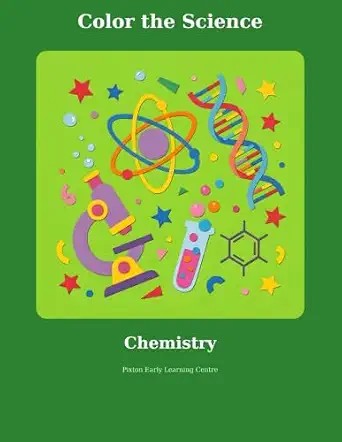
Volume Two · Available now
Chemistry
Atoms, molecules, elements, the periodic table, DNA, and the instruments used to see them.
Thirty-two pages establishing one idea: everything is assembled from smaller parts — including the child holding the crayon.
$12.99 · 32 pages · Paperback 8.5×11 in
Note for parents
The model they build here, they keep.
This volume hands your child the words atom, molecule and element years before school does. The mental picture they form is the one they’ll still be using at fifteen.
Volume One · Coming soon
The Solar System
The Sun, all eight planets, the Moon, and the bodies between them — moving outward from Mercury to Neptune.
Teaches scale and distance: that where a thing sits changes its temperature, its size, and the length of its year.
For parents: while your child colours Jupiter beside Earth, ask why one is larger. The habit of asking matters more than the answer.
With retailers for review. We’ll tell you the day it’s available.
One email when it ships. Nothing else.
Volume Three · Coming soon
Mathematics
Shape, pattern, symmetry, quantity, and the arithmetic hidden inside ordinary objects.
Treats mathematics as a description of structure rather than a set of operations to memorise.
For parents: pattern recognition predicts later mathematical achievement more reliably than early number fluency.
With retailers for review. We’ll tell you the day it’s available.
One email when it ships. Nothing else.
Using the books
A session takes ten minutes.
Look first
Open to the colour plate. Name what’s on it. Let the child study it as long as they want.
Colour second
Turn to the outline of the same subject. There is no correct palette. A purple Saturn is still a Saturn.
Talk last
Read the note printed for you, ask the question it suggests, and stop when attention goes.
Every volume
Forthcoming
Biology. Physics. Earth Science.
Drafted. Whether they’re published depends on whether these three prove useful — which we learn from what parents tell us.